Formal ontologists have long held that machines cannot reason reliably without explicit, structured, verifiable knowledge. For years, that conviction lived mostly at the rigorous edges of computer science and philosophy — essential to those who held it, easy for the broader market to overlook.
As organizations confront the limits of purely probabilistic AI, they are arriving at a conclusion the ontology community reached long ago: formal knowledge is the missing layer. Probabilistic systems can produce fluent answers, but they cannot explain, justify, or guarantee them.
But arriving at the moment and seizing it are not the same thing. That gap is where the challenge begins.
The market doesn’t just need ontologies. It needs ontologies that work in production — running inside real systems, in regulated environments, at scale. That is precisely where translating formal ontology into production software has traditionally required extensive engineering effort.
Moving rigorous ontology frameworks into production has traditionally required extensive engineering effort. The ontology itself remains intact, but the engineering translation often does not. As knowledge is manually interpreted and implemented, meaning, constraints, and relationships can be simplified or altered until the resulting software no longer faithfully reflects the original work.
That gap has real consequences now. The demand for formal reasoning has never been higher, and the path from rigorous research to real-world impact matters more than ever to the people who do this work, for their contributions, for their institutions, and for the future of the discipline itself.
In the environments where this matters most — clinical research, regulated industry, safety-critical systems — truth and accuracy are not negotiable. That is why a foundation built on approximation is no foundation at all. These domains cannot absorb knowledge that is probably right, roughly structured, and consistent most of the time.
That is exactly why the trained ontologist’s work cannot be shortcut. Formal rigor — consistency, verifiability, grounding in established standards like BFO 2020, is what makes an ontology trustworthy enough to build on. It is also what cannot be approximated into existence. The expertise isn’t becoming obsolete as the market matures. It is becoming essential.
But for that expertise to remain viable, it has to reach the world intact, and the next generation has to be able to develop it.
Reasonics is built on the formal standards this community established and maintains, BFO 2020 / ISO/IEC 21838-2, OWL, CLIF, and the OBO Foundry biomedical ontologies. These aren’t borrowed credibility signals. They are the platform’s native language. Frameworks built to these standards compile without compromise, and standards-compliant output preserves the original work’s formal rigor.
Full technical details are available on the Platform page.
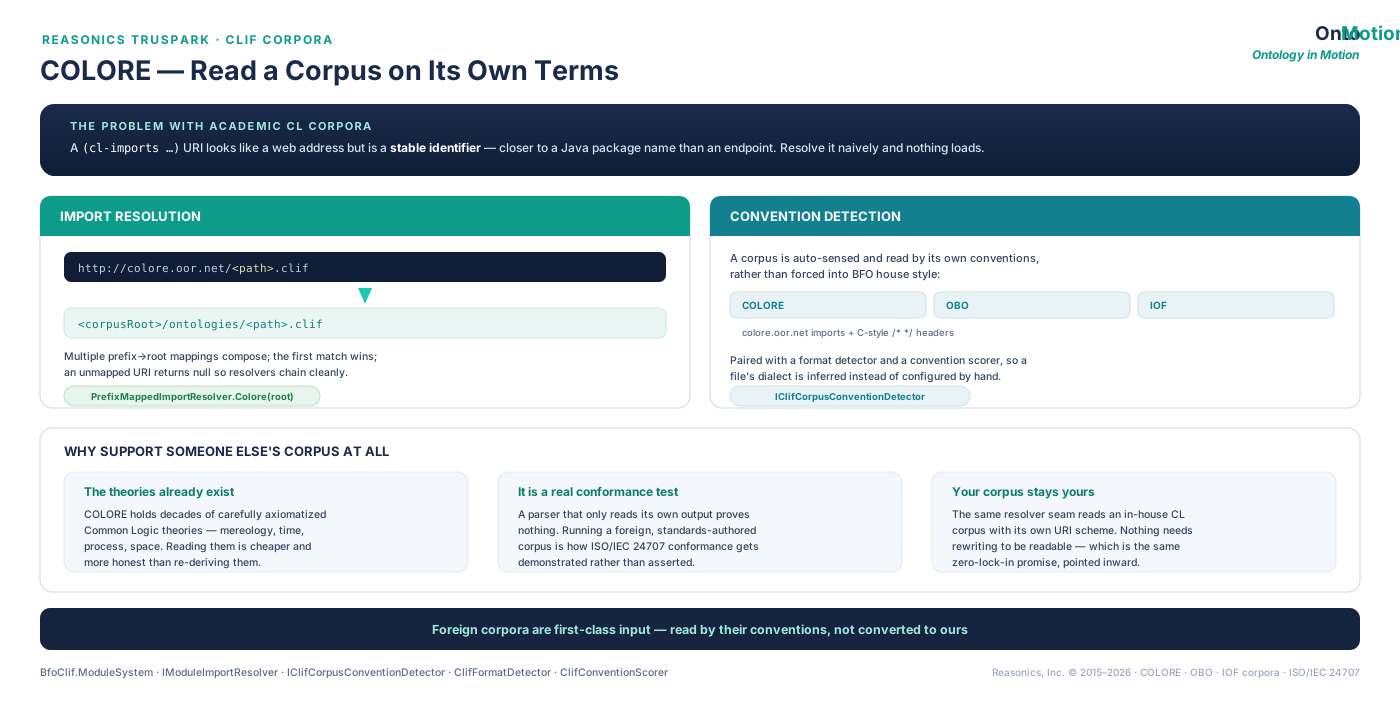
Years of formal ontology work already written in Common Logic aren’t stranded. Reasonics resolves a colore.oor.net import as the stable identifier it was meant to be — mapped to your local corpus, not fetched over the network, and auto-senses whether a corpus follows COLORE, OBO, or IOF conventions, reading each on its own terms rather than forcing everything into one.
The benefit is that the path from a research repository to a proved, executable system doesn’t begin with re-encoding your life’s work. Your corpus loads as it stands, and moves forward into a system that can prove and run it, with its rigor intact.
Foreign corpora are first-class input here, read by their own conventions and not converted to ours.
A (cl-imports …) URI looks like a web address, but it is a stable identifier — closer to a Java package name than an endpoint. Resolve it naively and nothing loads. Most tooling either fails here or asks you to rewrite your imports.
Mapped to your local corpus — never fetched over the network.
Multiple prefix-to-root mappings compose, and the first match wins. An unmapped URI returns nothing instead of guessing, so resolvers chain cleanly and you can point several corpora at one build.
That means a corpus with its own URI scheme, including one only your lab uses, is a configuration matter, never a porting project.
A corpus is auto-sensed and read by its own conventions rather than forced into BFO house style. A format detector and a convention scorer infer a file’s dialect instead of asking you to declare it.
COLORE is recognized by its colore.oor.net imports and C-style /* */ headers.
COLORE holds a large body of carefully axiomatized Common Logic theories — mereology, time, process, space. Reusing them is faster than re-deriving them from scratch.
A parser that only reads its own output proves nothing. Running a foreign, standards-authored corpus is how ISO/IEC 24707 conformance gets demonstrated and not asserted.
The same resolver seam reads an in-house Common Logic corpus with its own URI scheme. Nothing needs rewriting to be readable, the same no-lock-in commitment, pointed inward.
Resolution and detection are pluggable interfaces instead of hard-coded behavior: a prefix-mapped import resolver (with a COLORE preset), a corpus convention detector, a format detector, and a convention scorer, all reached through the module system. If your corpus needs a resolver we do not ship, it is an implementation of one interface, not a fork.
Your corpus loads as it stands.
Powered by OntoMotion™ · ISO/IEC 24707What the platform changes for formal ontology work. Expand any to see how.
Reasonics compiles formal ontologies directly into mathematically verified, executable software. That means the framework you build crosses the production boundary intact, no simplification, no loss of rigor, no handoff to a software team that doesn’t understand the formalism. The work reaches the world on its own terms, as what you actually built.
The barrier between formal research and deployed systems has always been software engineering. Reasonics removes it. Your expertise is in the knowledge, the concepts, relationships, axioms, and standards. The platform handles the path from that formal knowledge to working software, so the engineers consuming it never need to understand ontology, and you never need to become a developer.
Reasonics doesn’t just deploy finished work, its tooling actively supports the development of rigorous ontology skills. For emerging researchers and graduate programs, the platform provides guidance that accelerates progress toward formal competence, helping the next generation of ontologists build sound, standards-grounded work faster than apprenticeship alone can.
When formal ontology work visibly becomes real systems — adopted by industry, deployed in production, solving problems organizations actually have, the field stays relevant, fundable, and alive. In that way, Reasonics turns the gap between research and deployment from a chronic weakness in the discipline into a bridge for its future.
Send us an ontology from your own work in OWL, OBO, or SKOS and we will show you what it looks like as verified, executable software, the same logic you published, running in production, with your authorship intact.
See Your Ontology Compiled →