Trustworthy software isn't the product of a single feature. It is built up in layers, each one depending on the one beneath it. This page follows that chain of trust from end to end: from the meaning your organization defines, to the verified software TruSpark™ delivers. Each layer compounds the assurance established by the layer before it.
Select any layer to open its technical detail.
Everything starts with meaning made explicit. A formal ontology defines the concepts, relationships, and rules of your domain precisely, and grounds them in a shared upper-level standard (BFO 2020) so that a term means the same thing across every domain, department, and system that uses it. That shared foundation is what lets knowledge from different parts of the organization work together instead of quietly conflicting, the misalignments that are expensive to discover late and harder still to unwind.
A taxonomy is an excellent starting point, organizing and classifying concepts into a clear hierarchy is genuinely valuable, and it is often where formal ontology work begins. A formal ontology extends beyond classification: alongside organizing concepts, it represents their meaning, the relationships between them, the constraints that govern them, and their logical behavior, in a form that can be reasoned over and formally verified. Put simply, a taxonomy tells you how concepts are categorized. A formal ontology also lets a machine reason about what those concepts mean and check that the result is consistent.
Domain ontologies model knowledge within a specific field exceptionally well. A top-level ontology like BFO adds something a domain ontology cannot provide on its own: a common semantic foundation that keeps meaning consistent across many domains, departments, and enterprise systems. When every domain ontology is grounded in the same upper ontology, a concept defined in one place carries the same meaning everywhere it is used, so knowledge from different areas can be combined without the terms quietly drifting apart. Both layers have a role, the domain ontology captures the specifics of the field, and the top-level ontology preserves shared meaning across all of them.
For software to reason about what your organization knows, that knowledge has to be written down in a language precise enough to leave no room for interpretation. Everyday modeling tools keep things simple so they stay fast, but simplifying is exactly what you cannot afford when a single definition carries regulatory or safety weight.
That is why TruSpark writes meaning in Common Logic (CLIF), a mathematical language that captures the full nuance of a regulated domain instead of a stripped-down approximation of it. The relationships, constraints, and rules that make your field what it is come through intact, ready to be proved and not merely stored.
CLIF is itself an international standard — ISO/IEC 24707:2018, so the language your meaning is written in is governed and auditable, not something Reasonics invented and asks you to take on faith.
If your organization already has knowledge in OWL, OBO, or SKOS, TruSpark lifts it in and grounds it in CLIF automatically. You don’t rebuild what you already have.
Your ontology investment survives the move. Each format family gets a complete translation stack, never a thin shim that handles the easy cases and quietly loses the rest.
Bringing your ontology in is not an unchecked import. The lift runs as a verified workflow, proved before it executes, audited while it runs, on the same engine we ask you to trust for your own knowledge.
Each family ships a workflow project executed by Sequent: verified by Sequent Algebra before execution, audited by Sequent Signal during it, with HTML reports produced as a record. We run our own platform to ingest your ontology rather than demonstrating it on something easier.
Every generated artifact carries a provenance record of what produced it, from which source file, under which proof, so months later, no one has to reconstruct where a definition came from.
Provenance is written using W3C PROV-O on the emit side and not treated as an input format, through a provenance sink and an annotation overlay applied to generated artifacts.
Your existing ontology comes across intact. You do not write it a second time.
Powered by OntoMotion™Many knowledge representations are designed for classification and fast lookup, which means they intentionally limit how much can be expressed so that reasoning stays quick and predictable. Common Logic takes a different approach: it can express the full richness of a domain's meaning — relationships, constraints, and rules, and it supports formal reasoning over all of it, not just classification. TruSpark uses Common Logic because preserving meaning across an enterprise requires representing that meaning completely, and then being able to prove things about it.
Standards are what let someone outside Reasonics check our claims. When a system conforms to a published, independently governed standard, its behavior can be audited, reproduced, and relied on by regulators, partners, and your own engineers, without anyone having to take our word for it. TruSpark is built on recognized standards at every layer:
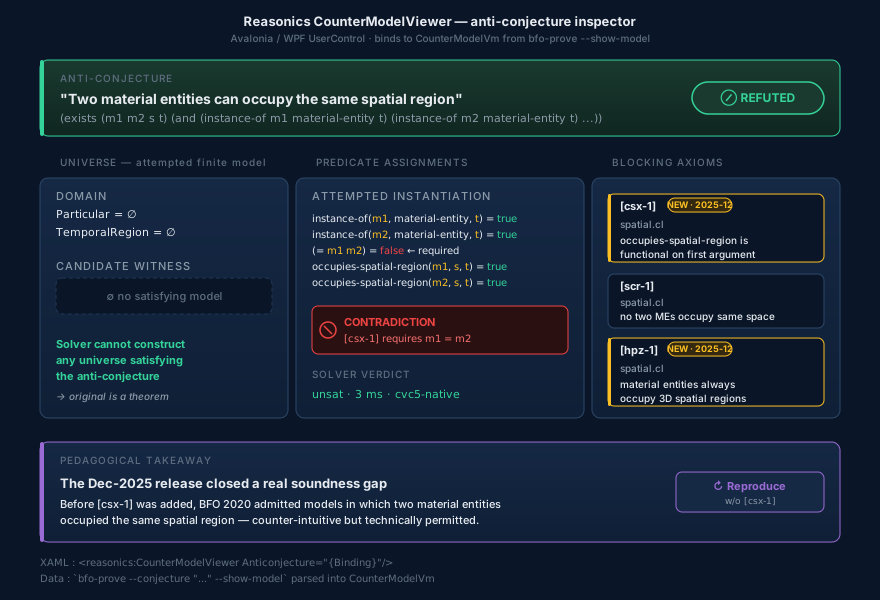
Before any software is generated, the knowledge is submitted to automated theorem provers that check it is internally consistent and that its conclusions genuinely follow. This is proof, not testing, and a result that cannot be proved is reported honestly as indeterminate, never guessed.
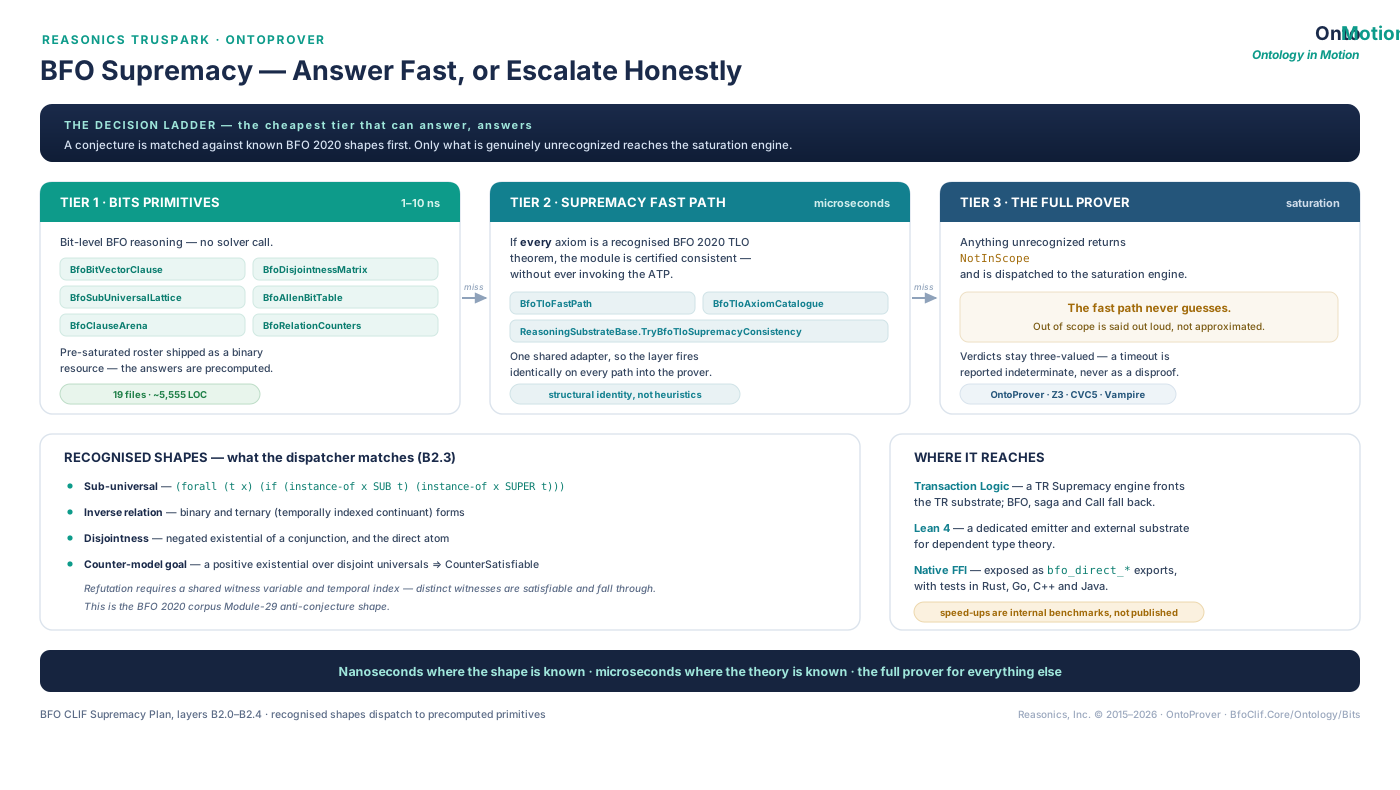
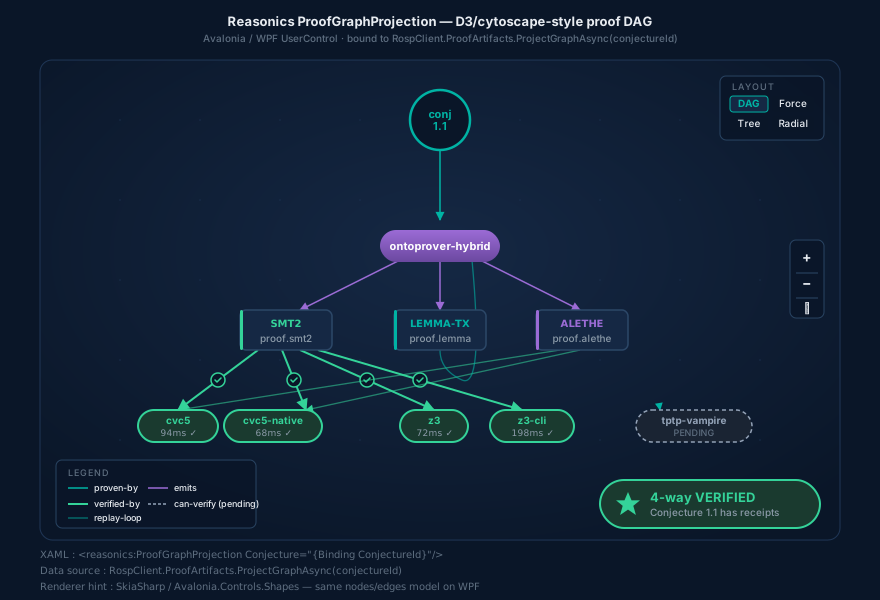
TruSpark does not rely on a single prover. It runs a portfolio of automated theorem provers under one interface, because different provers are suited to different kinds of problems, and a result that several independent provers agree on is far more trustworthy than one from any single tool.
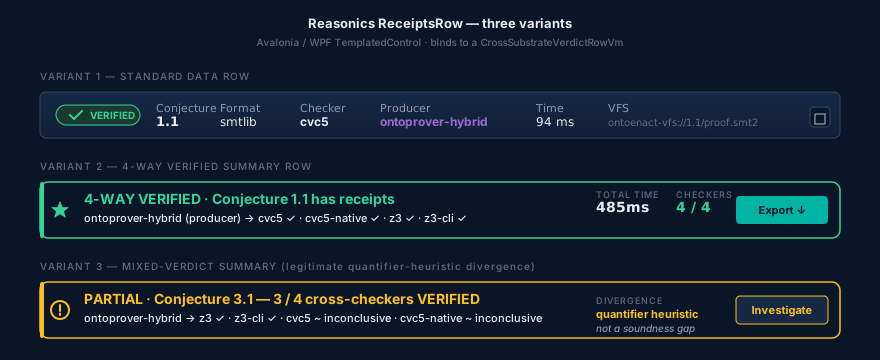
Different provers are good at different things. TruSpark routes each problem to the prover best suited to its shape. For high-assurance work you can go further and require cross-verification: two engines run the same question concurrently, and the verdict is only promoted when both agree. A one-sided proof the second engine cannot confirm is reported as indeterminate rather than accepted, and outright disagreement is surfaced as its own verdict instead of being resolved silently. That is what makes a proof defensible and not merely asserted, and disagreement between reasoners is treated as information, never something to hide. OntoProver™ is Reasonics’ own prover in the portfolio, purpose-built for BFO 2020 reasoning and emitting independently replayable certificates in TSTP and Alethe; Z3, CVC5, and Vampire are industry-standard provers used by verification teams worldwide. No single external prover combines BFO-native optimization with that independent certification.
Pick a formal statement and watch the prover portfolio reach a verdict — proved, or honestly reported as indeterminate.
Pick a statement
(forall (s c)
(if (specifically-depends-on s c)
(and (exists (t) (and (exists-at s t) (exists-at c t)))
(forall (t) (if (exists-at s t) (exists-at c t))))))
If s specifically depends on c, they coexist at some time, and c exists at every time s does.
A dependent entity cannot outlive its bearer.
TSTP . replayable without Reasonics in the loop
OntoProver is Reasonics’ own automated theorem prover, built specifically for BFO 2020 ontological reasoning, with its own tableau, resolution and superposition engines, and a native SMT solver: a DPLL(T) core driving five theory solvers. Three of those are BFO-native — mereology, category disjointness and temporal reasoning — alongside the BFO sort lattice and linear arithmetic. It reads and writes SMT-LIB 2.7 across QF_UF, UF, AUFLIA and AUFLIRA. That is the part an off-the-shelf SMT solver cannot supply: a decision procedure that already knows what parthood and disjointness mean. Z3, CVC5, and Vampire are industry-standard provers used by research institutions and verification teams worldwide, each bringing different strengths to the portfolio.
An inconsistent theory is rejected outright. A theory that contains a logical contradiction can prove anything vacuously, so TruSpark refuses to build on one.
For the business, this is the difference between a system whose answers you hope are right and one whose answers you can defend. Because every conclusion is proved before anything is built on it, the software your teams ship carries meaning that has already been checked, so a decision can be explained to a regulator, reproduced by an auditor, and relied on by the people downstream, without anyone having to trust that the logic simply happened to be correct. Correctness stops being a matter of confidence and becomes a matter of record.
The core runs on first-order logic in CLIF, but real questions also ask about time, obligation, actions, and exceptions. TruSpark ships logic extensions for those, while holding the same line on genuine proof. Pick a family below to see its members. The tag on each says whether the platform proves it directly today, handles part of it, or hands it to a specialist tool.
The platform answers instantly when it recognizes a known pattern and escalates to the full prover only when it needs to, and when it genuinely cannot decide, it says so honestly instead of guessing.
Verification only helps if it is fast enough to live inside a working day. Because the knowledge is anchored to BFO 2020, a great many questions have known answers, so the cheapest tier that can answer, answers, and anything the shortcuts do not genuinely recognize goes to the full prover rather than being waved through.
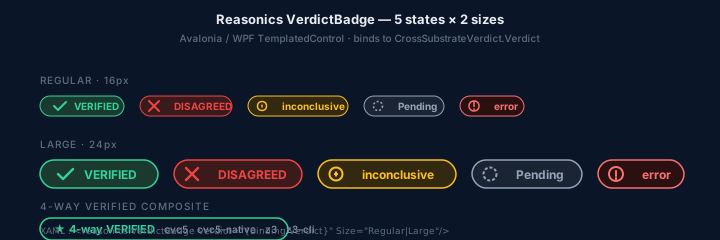
Matching is structural. A refutation requires a shared witness variable and temporal index — distinct witnesses are satisfiable and fall through to the next tier instead of being reported as a contradiction. The shapes follow the BFO 2020 corpus anti-conjecture form, expressed in CLIF as (forall (t x) (if (instance-of x SUB t) (instance-of x SUPER t))) and its relatives.
The same escalate-honestly rule governs transaction logic, dependent type theory through Lean 4, and the native bindings your developers call from Rust, Go, C++, and Java.
speed figures are internal benchmarks, not published resultsMost questions never reach the prover. The ones that do are not hurried.
Powered by OntoMotion™Once a theory is proved, TruSpark compiles it into executable software. Compilation is gated on verification: a build that succeeds but contains anything that does not match its proved source is treated as a defect, not a release.
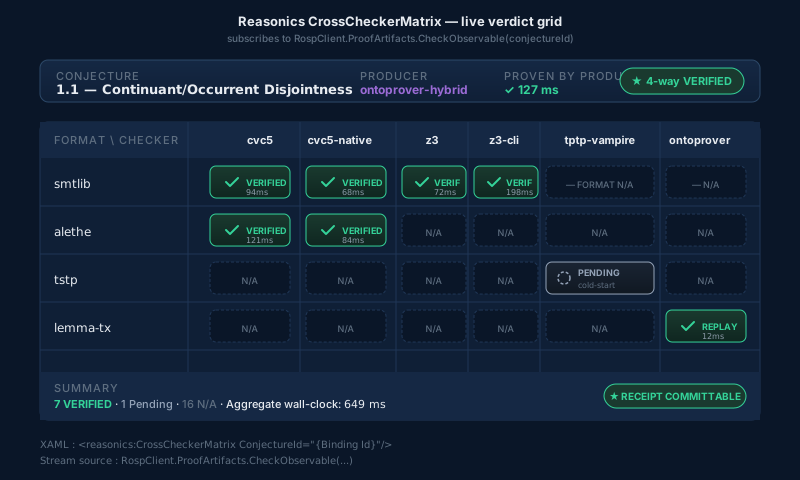
Reasonics calls this principle verification-first emission. Every artifact emitted, in every language, across every deployment target — carries the same machine-checked semantics and an independently replayable proof certificate. It is the difference between trusting software because you read its documentation and trusting it because a machine proved its claims.
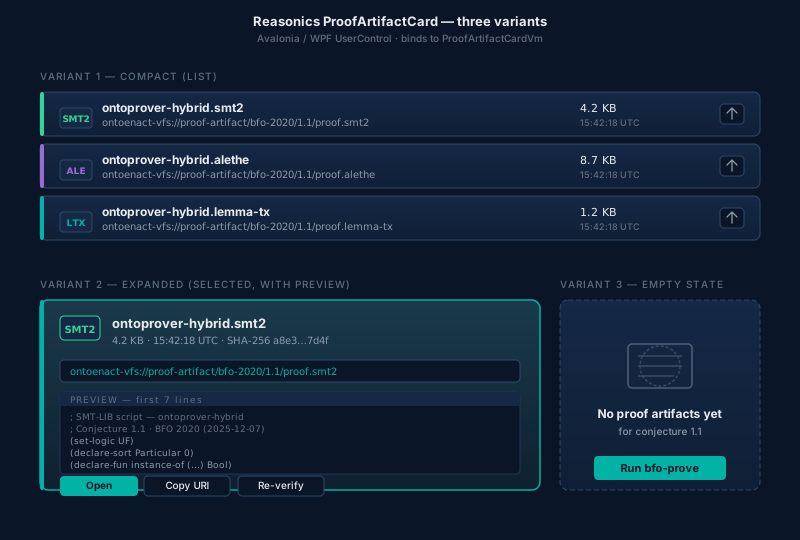
Every proof produces a certificate, a portable, machine-checkable record of exactly how a conclusion was reached. You do not have to take Reasonics’ word for it: a certificate can be replayed in an independent checker, with TruSpark nowhere in the loop.
Certificates are emitted in three independently verifiable formats — TSTP, Alethe, and SMT-LIB 2.7.
Each figure carries its own evidence. Click a stat to see exactly what it measures — and, just as important, what it doesn’t.
TruSpark's compiler works with 40 formal categories (universals), the standard 35 BFO categories plus five meta-ontological terms used internally by the sorted reasoning pipeline. The axiom count is identical. The encoding differs.
304 formal statements are catalogued in TruSpark's BFO conjecture registry. A smaller set runs under proof-gated verification. These two counts measure different things, a platform that conflates them is imprecise.
More than 150 generated SDK trees, with 147 named entries in the ontology manifest, have been compiled through the identical pipeline, including the platform's own internal systems. TruSpark uses the SDKs it generates in its own production infrastructure.
TruSpark's CLIF parser has been tested against COLORE, a large public benchmark repository of Common Logic ontologies contributed by multiple independent research groups — achieving a 99.87% successful parse rate across 3,118 files — 3,114 parsed, with four documented defects. This measures the parser's robustness across real-world inputs from sources outside Reasonics. It is a parse-pass rate, not a proof-verification rate: successfully reading a file and formally proving it correct are different claims, and TruSpark does not conflate them.
Finally, the verified core is delivered into your environment as build-ready software your teams can use directly, in the languages they already work in, with the evidence from the layers above traveling alongside it. The assurance built up across the previous five layers arrives as something your teams can ship, never a report someone still has to act on.
In six languages — C#, Rust, Go, C++, Java, and Python, each with entity classes, query providers, axiom registries, and validation logic. These are build-ready libraries, not wrappers or stubs.
Interactive applications in each language that let engineers and domain experts explore the compiled ontology directly, without formal logic expertise. Twenty modules covering entities, relations, temporal reasoning, validation, live theorem proving, and more.
In TSTP, Alethe, and SMT-LIB 2.7, independently replayable without TruSpark in the loop.
Through W3C PROV-O (the W3C international standard for data provenance), embedded in every compiled artifact, a formal record of the knowledge that produced each output and the verification it passed through.
Derived directly from the verified ontology and consumed by TruSpark's runtime graph engine to execute over your instance data, the graph structure comes straight from the proved knowledge, not maintained separately.